

- History of the Ride
Riding the boundary of Lichfield since 1553
How a Tudor charter gave Lichfield its own Sheriff, what the Sheriff did, the route of the old boundary, and the ride through the years.
It all begins in 1553
… or perhaps just a few years before.
1549Edward VI grants Lichfield the title of City1553Queen Mary's charter creates the City and County8 SeptThe Nativity of the Virgin Mary: the day of the ride20+ miAround the old boundary… the second year of Edward the Sixth (1549), when that king, by charter, durante beneplacito, dignified it with the title of City; appointed bailiffs, and other chief officers; granted them power to hold all pleas within the city, suburbs, and precincts thereof; and, that the limits of the same, then being in the county of Stafford, might be better known, authority was given to the bailiffs, &c. On the first day of May, yearly, to make perambulation around the city, &c. by view of the sheriff of Staffordshire.
History of the City of Lichfield, John Jackson, 1805It is hard for us to imagine the importance of this to the citizenry of Lichfield. The ability to hold pleas (court cases) within the City would have given them quick access to justice for minor crimes such as minor theft, drunkenness, trespass and debt. The most serious cases, such as murder, witchcraft and rioting, would still have had to be dealt with by the Sheriff of Staffordshire to be passed on to the assize courts, where a judge and jury would pass judgement, presumably far away in Stafford.
It must have annoyed the Sheriff of Staffordshire to have to come over to Lichfield on the 1st of May and supervise the perambulation of the boundary.
The before-mentioned charter was confirmed, by the charter of queen Mary, in the first year of her reign (1553), and by authority of Parliament. By the same charter, the court of record, granted to be holden for ever, in all pleas arising within the city, &c. the action should be before the bailiffs and citizens; and if it cannot be determined there, then before the justices next coming into the city, and not out of the city, or before any other justices.
That the city, suburbs, &c. which then were in, and parcel of, the county of Stafford, from the ensuing feast of St. Thomas, should be a city and county of itself, for ever, and not parcel of Staffordshire. That there should be one sheriff of the city and county of Lichfield, to be chosen on the feast of St. Thomas, and continue till that of St. Michael; and then another to be chosen, &c.
That the said sheriff should, yearly on the feast of the Nativity of the blessed Virgin Mary, perambulate the limits of the city, &c. as heretofore, that the boundaries thereof might be better ascertained.
These great privileges, were granted in consequence of the faithful services of the bailiffs and citizens in time of rebellion.
History of the City of Lichfield, John Jackson, 1805So it was in 1553 that a charter provided Lichfield with visiting justices for the more serious crimes, and a sheriff! The major court cases (and all that money from fines) no longer went to the Sheriff of Staffordshire.
The office of Sheriff
A great honour, and often a very costly one.
It was a significant honour to be appointed sheriff but that honour was often very costly. If the people of the County of Lichfield did not pay the full amount of their taxes and fines, the sheriff was required to make up the difference out of his own pocket. Furthermore, the sheriff was expected to serve as host for judges and other visiting dignitaries, providing them with protection, accommodation and lavish entertainment, all at his own expense.
For these reasons, the office of sheriff was not often sought after. In fact, many well-qualified men did everything they could to avoid being chosen. The law on this point was quite clear: if a man was chosen to be sheriff, he had to serve or (yes, you have guessed it) be fined!
⚖️Law and order
Sheriffs were responsible for maintaining law and order, presiding over the county court with the visiting justices and carrying out the sentences passed down by the justices. They were also responsible for the annual payment that each shire made to the king at the Exchequer (just like the Sheriff of Nottingham!), as well as other debts owed to the king, such as the proceeds from the county courts.
👥The 'view of frankpledge'
One duty was to supervise the biannual 'view of frankpledge', at which he checked that all adult free men were in 'Tithings' (ten + thing), the ten-strong groups. Everyone in a Tithing was responsible for the behaviour of the others in the group. If one of them broke the law, the others were responsible for catching them and taking them to court. If they didn't, the whole Tithing was fined. Imagine one pupil in a school class misbehaves. The teacher demands "Who did it?" but nobody owns up, so the teacher puts the whole class in detention. That is the way the Tithing system worked.
🔍Crime and the gaol
The Sheriff investigated major crimes with the help of a jury of local people, who would swear an oath to say who they believed had committed the crime. The Sheriff would then hold the criminal after capture in the local gaol. You can still see part of the original Lichfield gaol at the back of the Guildhall.
🐎The posse
A Sheriff could organise a posse comitatus (power of the community) to deal with an emergency such as a riot, to catch a felon, or to arrest those who prevented the execution of a writ (for example, for seizing property to satisfy a debt). This is why Sheriffs of the Wild West organise a 'posse' to chase the outlaws!
Riding the boundary
The main duty of our sheriff was to annually perambulate the boundary of the City and County of Lichfield, a distance of over 20 miles. This is the tradition that we are trying to maintain. We hope you will support us.
Read the Sheriff's Oath
I …………………… do solemnly declare that I will well and truly serve the King's Majesty in the office of Sheriff of the City of Lichfield, and promote His Majesty's profit in all things that belong to my office so far as I legally can or may; I will truly preserve the King's rights and all that belongeth to the Crown; I will not assent to decrease, lessen, or conceal the rights of the King or of His Franchises; and whenever I shall have knowledge that the rights of the Crown are concealed or withdrawn in any matter or thing I will do my utmost to make them be restored to the Crown again; and if I may not do it myself I will inform the King or some of His Majesty's Judges thereof; I will not respite or delay to levy the King's debts for any gift, promise, regard or favour, where I may raise the same without great grievance to the debtors; I will do right as well to poor as to rich in all things belonging to my office; I will do no wrong to any man for gifts, reward or promise, nor for favour or hatred; I will disturb no man's right, and will truly and faithfully acquit at the Exchequer all those of whom I shall receive any debts or sums of Money belonging to the Crown; I will take nothing whereby the King may lose or whereby her right may be disturbed, injured or delayed; I will truly return and truly serve all the King's writs according to the best of my skill and knowledge; I will take no Bailiffs into my service but such as I will answer for; I will truly set and return reasonable and due issues of them that be within my Bailiwick according to their estate and circumstances, and make due panels of persons able and sufficient and not suspected or procured as is appointed by the statutes of this realm; I have not sold or let to farm nor contracted for nor have I granted or promised for reward or benefit, nor will I sell or let to farm nor contract for, or grant for reward or benefit by myself or any other person for me, or for my use directly or indirectly my Sheriffwick or any bailiwick thereof, or any Office belonging thereunto, or the profits of the same to any person or persons whatsoever. I will truly and diligently execute the good laws and statutes of this realm and in all things well and truly behave myself in my office for the honour of the King and the good of His subjects and discharge the same according to the best of my skill and power.
The annual perambulation of the boundary
Where do we go? Follow the old description of the City and County of Lichfield.
Harwood's The History and Antiquities of the City of Lichfield (1806) describes the boundary but doesn't say which "ancient writings" he is referring to. Try following this description:
The boundaries of the city of Lichfield, according to ancient writings, are a circuit of about sixteen miles:
The History and Antiquities of the City of Lichfield, Thomas Harwood, 1806"It begins at a place called the Cross and Hand, near the end of a street there, called Bacon-street, and from thence goeth northward along the lane leading to Longdon Church, unto a little Lane (now called Featherbed-lane) at the further side of Oakenfields, and so along that little cross-lands unto another lane that leadeth from Lichfield to King's Bromley; and then along that lane towards Lichfield, unto a little lane lying between the Grange Ground and Collin's Hill Field, commonly called the Circuit lane, unto the further end of it betwixt two fields, the one called Hic-filius, and the other Piper's Croft; and so over across a lane that leadeth from Lichfield to Elmhurst, and then into another little lane between Stichbrooke Ground and Gifforde's Crofte; and so along that little lane to a green lane at the further side of the Lady Leasowe, being the land of Zachary Babington, Esquire, and down that lane to a brook, called Pone's Brook;
and so over that brook into another lane, called Stepping-stones-lane; and so along that lane, taking in the land of Richard Pyott, Esq. called Pone's Fields, unto a lane leading from Lichfield to Curborough Somerville; and so along that lane towards Lichfield, until you come to the upper end of the grounds, called Scott's Orchard; and then, leaving that lane, turn into a field of Lichfield, called Whisich, at a stile going into the fields, called Browne's Fields; and so taking in the field, called Whisich, then go by the closes, called Browne's Fields Hedge, unto the grounds called God's Croft Hedge; and so along that hedge, taking in the field called Whisich, unto a lane called Goslinge's-lane; and so along Goslinge's-lane, unto a lane called Matthew-Coal-lane;
and so over across that lane into a field called Cross-field, at or near an elm tree, and so along a head-land about the middle of Crossfield, unto the nearer end of Gorsty Bank, into the lane leading from Lichfield to a cross-way called Burton-turnings; and from thence along Ikeneld-street, taking in Spear-hill and Boley, unto a cross-way leading from Lichfield to Whittington; and so along that lane, towards Whittington, unto the south end of Austin's Coat Grounds; then turning upon the left hand at that brook, to a gate going into Fulfin Grounds, unto the moors called Dernford Moors; and so along by the hedge of those moors unto the nether side of Dernford Mill stream; and so going by the mill-door to the pool-dam, and going along by the pool and the brook, taking in Horslade, and a meadow belonging to Freeford House, unto a bridge called Freeford Bridge, in a lane leading from Lichfield to Tamworth;
and so from that bridge, up the sandy lane, to Freeford House, and along that lane to the corner of the meadow; and then turning into Bispells (Bishopshull), at the corner of the meadow, and so going by the meadow hedge, until you come to the brook that runneth to Freeford Bridge, and so going up a little pool, taking in all Bispells, unto a ford called Baltrex-ford; and then entering into Old-field, turn up the left hand to the brook that runs from Freeford Pool, and so along that brook to Freeford Pool, and along by the pool and the brook that comes from Swynfen Mill, until you come into that lane that leads from Swynfen unto the mill; and so along that lane to a gate that leads from Lichfield unto Swynfen, called Old Field Gate; and then not coming in at that gate, but going to the corner of the hedge adjoining to Cley Lands, come in at a gap, and, taking in all Old-field, come by the demesnes of Swynfen unto a place called Long-bridge,
and so entering into a little lane between Long-furlong and Long-bridge grounds, leading to Well-crofts, and so taking in all Well-crofts, along by the Knowle Leasowes, being the Hospital Land, unto Ikeneld-street; and so along Ikeneld-street, unto the further side of a close called Gorsty Leasowe; and leaving the hedge on the left hand, taking in that close, going along by that hedge leading to Hare-house Ground, and so along that hedge unto the top of Dean's Slade; taking in all Hare-house Ground, northward, enter into Park-field, leaving the hedge on the right hand, and so following that hedge unto a little lane at Aldershawe, that comes down that lane to the gate, and through the gate; then turn upon the left hand by Aldershawe Hedge, taking in the barn, and so go into the Wheat Close, leading the hedge on the left hand unto the road called the Fosseway, up to the top of Mickle-hill;
then crossing over Pipe-green, along an old decayed cart-way, into a lane-end that leads to Pipe-grange-lane, to the further side of Padwell's; and so taking in Padwell's, leaving the hedge on the left hand, to a little lane that leadeth into Ashfield, leaving the hedge on the left hand, into the grounds called Lammas Grounds, and leaving the hedge on the left hand, and so into Lemondsley; then following the brook to Pipe-green gate, and so along the brook in Pipe-green, into a little lane that butteth upon the lane that leadeth from Lichfield to Pipe, and crossing that lane into Smithfield, at the corner of Abnell Hedge, and so taking in all Smithfield, leaving Abnell Ground on the left hand, unto the Cross and Hand, where it began."
"This perambulation is annually made on the eighth of September according to the charters, by the Sheriff and City Officers."
Ride the boundary yourself
The modern ride follows the old boundary as closely as roads and bridleways allow.
The City and County of Lichfield
Forget your sat-nav.
Make your way to the City and County of Lichfield using the Britannia Depicta by John Owen and Emanuel Bowen, from about 1720. The full Coventry to Lichfield map can be found at www.fromoldbooks.org. On the bottom of the map it even describes the Sheriff's Ride:
LICHFIELD anciently called LICIDFELD i.e. Campus Cadaverum, from the many Martyrd Bodies in the Dioclesian Persecution; being (a Thousand Christians) the Disciples of St Amphibalus, who were Massacred in a Field called Christian Field, and their Carcasses exposed to Wild Beasts; whence it bears for its Device an Eschouchon of a Landskip in which is Represented 3 Slain Kings. This City is a County of itself; containing about 10 or 12 Miles in Compass Surrounded every Year (Viz.t) September 8th by the Sheriff who then Feasts the Corporation & Neighbouring Gentry: By Charter Edward 6th the Government consists of 2 Bailiffs, chosen Yearly out of 21 Brethren, a Recorder, Steward, Sheriff &c. Members of Parliament are chosen by the Free-men Free-holders and Burgess Tenors, paying Scot and Lot. Here are 3 Parish Churches, and a Cathedral. Markets Tuesday and Fryday. Fairs Ashwednesday, May-day and the Friday before St Simon & Jude.
Britannia Depicta, Owen and Bowen, c. 1720A coaching city
Lichfield had a lively coaching trade as a stop-off on the busy route between London and Chester from the 1650s onwards, making it Staffordshire's most prosperous town. In the 18th century, reaching its peak in the period from 1800 to 1840, the city thrived as a busy coaching city on the main routes from London to the north-west and Birmingham to the north-east.
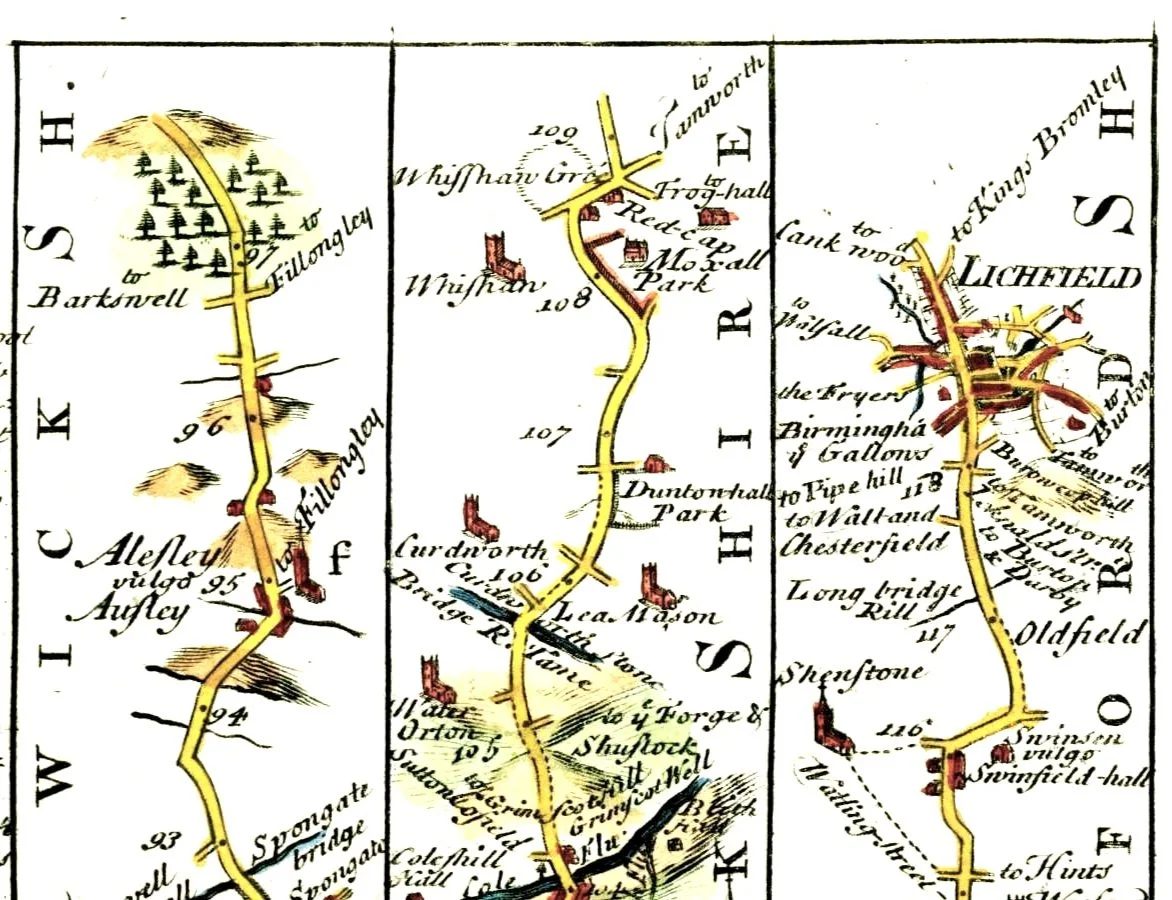
Britannia Depicta (1720). Source: www.fromoldbooks.org 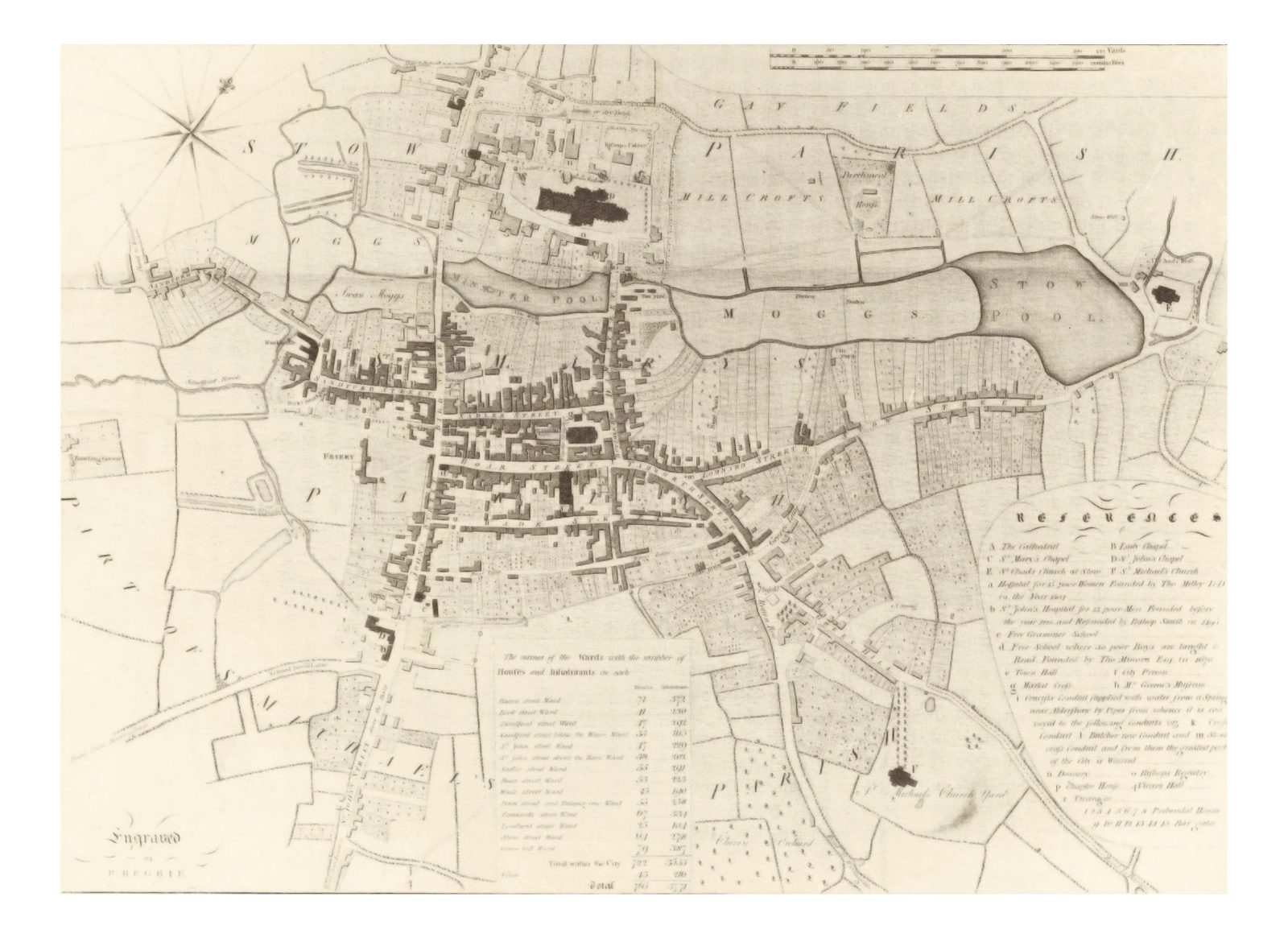
J. Snape, A Plan of the City and Close of Lichfield (1781). Source: Lichfield, Wikipedia. 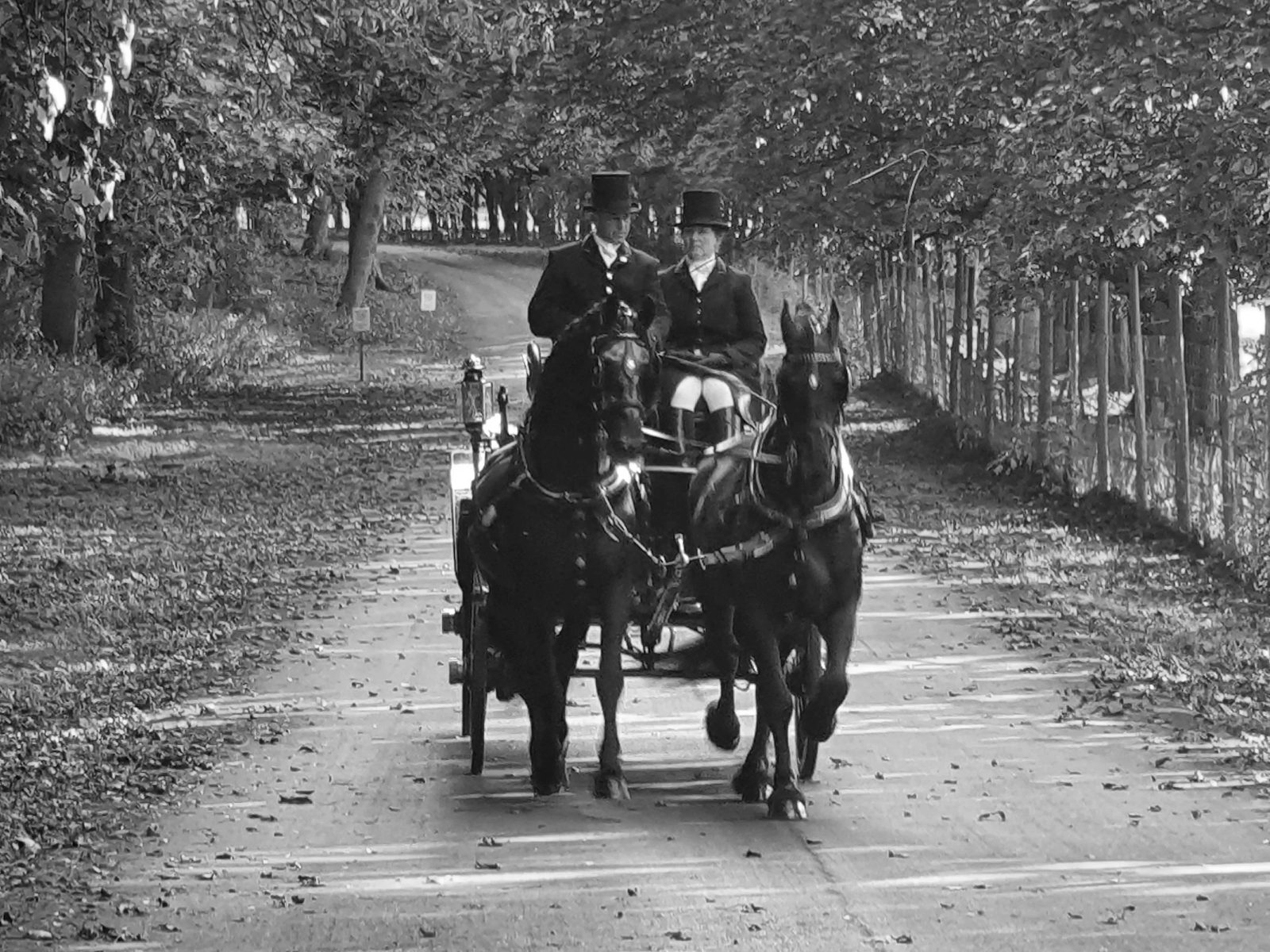
Lichfield was a stop on the coaching routes from London to Chester and the north-west. The ride through the years
Photographs of the Sheriff's Ride, from the oldest images we have to the present day.
1908The oldest images we have
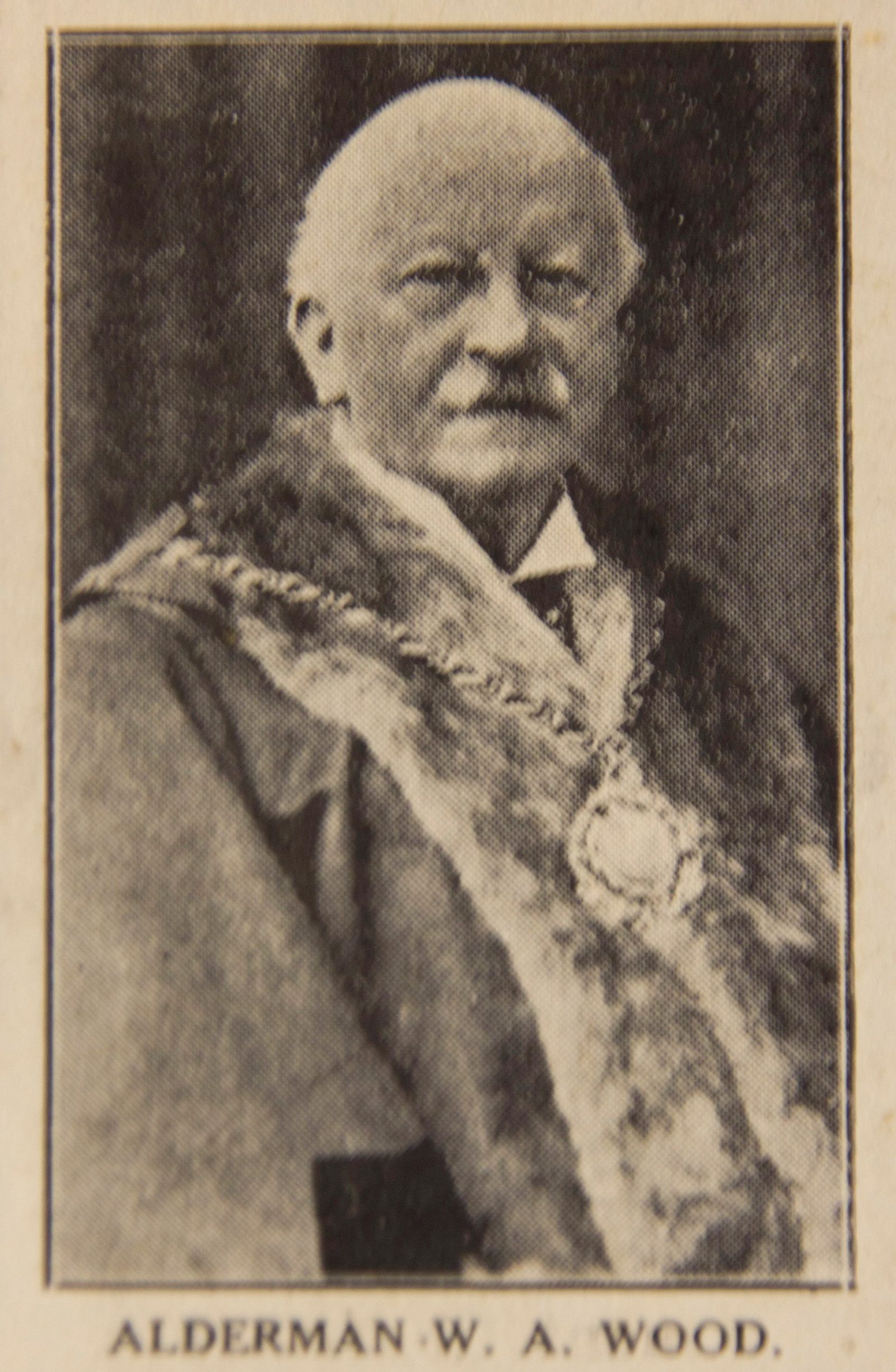 Sheriff 1908William Arthur Wood1910
The Sheriff's Ride at the Horse & Jockey
Sheriff 1910Frederic Dand Winterton1918An invitation from the Sheriff
An invitation from Sheriff J. R. Deacon for the Sheriff's Ride on 7 September 1918.
1947The ride enters Bore Street
2019The last ride organised by the City Council
The last Sheriff's Ride to be organised by Lichfield City Council.
2023A new chapter: cycle and equestrian rides
Combined cycle and equestrian events, organised by a group of supporters trying to maintain the tradition of annually riding round the boundary of the City and County of Lichfield.
 Sheriff 2023Adam Burns-MaceToday
Lichfield Sheriff's Ride CIO
We organise the Sheriff's Ride (the perambulation of the boundary of the old City and County of Lichfield, in accordance with the 1553 Charter) as an equestrian and cycling event, promoting and supporting the office of the Sheriff of Lichfield and its associated traditions. Registered Charity No. 1215898.
Be part of the next chapter
The next Sheriff's Ride is on Saturday 11 September 2027.